

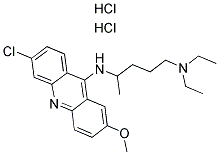
| 中文名称 | 二盐酸奎吖因水合物 |
| 英文名称 | QUINACRINE DIHYDROCHLORIDE |
| CAS号 | 69-05-6 |
| 分子式 | C23H32Cl3N3O |
| 分子量 | 472.88 |
| EINECS号 | 200-700-8 |
| 熔点 | 249-251℃ (Decomposition) |
| 密度 | 1.2962 (rough estimate) |
| 折射率 | 1.6300 (estimate) |
| 溶解度 | 可溶于DMSO(轻微)、甲醇(轻微、超声处理)、水(轻微) |
| 形态 | 黄色固体 |
| 酸度系数(pKa) | pKa -6.3(H2Ot undefinedI not reportedbut low) (Uncertain) |
| 颜色 | 浅黄色至厚黄色 |
| PH值 | 3.0~5.0 (20g/l, 25℃) |
| 水溶解性 | Water: 33.33 mg/mL (70.48 mM) |
| 默克索引编号 | 14,8044 |
| BRN | 4834013 |
| 稳定性 | 稳定的。与强氧化剂不相容。 |
| 危险品标志 | Xn |
| 危险类别码 | 22-36/37/38 |
| 安全说明 | 36/37/39 |
| WGK Germany | 3 |
| RTECS号 | AR7875000 |
| 毒性 | LD50 oral in rabbit: 433mg/kg |
| Target | Value |
|
PLA2
() |
Quinacrine (5-20 μM; 24 hours) inhibits the growth of SGC-7901 cells.
Quinacrine (7.5 and 15 μM; 24 hours) induces apoptosis in SGC-7901 cells, which is associated with mitochondria-dependent signal pathway and involves p53 upregulation and caspase-3 activation pathway.
Quinacrine (15 μM; 24 hours) treatment significantly increased the levels of proapoptotic proteins, including cytochrome c, Bax, and p53, and decreased the levels of antiapoptotic protein Bcl-2, thus shifting the ratio of Bax/Bcl-2 in favor of apoptosis .
Cell Viability Assay
| Cell Line: | SGC-7901 cells |
| Concentration: | 0, 5, 10, 15, and 20 μM |
| Incubation Time: | 24 hours |
| Result: | Cell viability was inhibited in a dose-dependent manner, and the mean IC 50 value is 16.18 μM. |
Apoptosis Analysis
| Cell Line: | SGC-7901 cells |
| Concentration: | 7.5 and 15 μM |
| Incubation Time: | 24 hours |
| Result: | The percentage of apoptotic cells, including the early phase and late phase apoptosis, increased to 26.30%, compared with control group of 3.37%. |
Western Blot Analysis
| Cell Line: | SGC-7901 cells |
| Concentration: | 15 μM |
| Incubation Time: | 24 hours |
| Result: |
The relative quantity of cytochrome c protein was upregulated, increased from 0.10 to 0.24.
The relative quantity of p53 protein was dramatically increased, from 0.06 to 0.19. The Bax/Bcl-2 ratio was dramatically elevated from 1.21 to 2.59. |
Quinacrine (100 mg/kg three times per week for two consecutive weeks) significantly suppresses circulating blast cells at days 30/31 and increases the median survival time (MST). Quinacrine does not decrease the body weight of treated animals at the tested dose.
| Animal Model: | Female SCID mice with acute myeloid leukemia (AML)-PS model |
| Dosage: | 100 mg/kg |
| Administration: | Administered by oral gavage (po); three times a week for two consecutive weeks |
| Result: |
In the first AML mouse in vivo study, evaluation of circulating leukemic cells detected in blood samples (in percent of white blood cells (WBC)) at day 30/31 showed 72% human tumor cells in the control mice, whereas in mice treated with Quinacrine, this was only 2.2%.
The MST of control mice was 34 days whereas it was 46 days in Quinacrine-treated mice. |
-
CAS号:915019-65-7
Dactolisib (BEZ235) -
CAS号:6151-30-0
米帕林盐酸盐 -
CAS号:875320-29-9
Quisinostat -
CAS号:404950-80-7
帕比司他 -
CAS号:103775-75-3
米帕 -
CAS号:83-89-6
疟涤平 -
CAS号:1032350-13-2
MK-2206 2HCl -
CAS号:152459-95-5
伊马替尼 -
CAS号:159351-69-6
依维莫司 -
CAS号:915019-65-7
Dactolisib (BEZ235) -
CAS号:6151-30-0
米帕林盐酸盐 -
CAS号:875320-29-9
Quisinostat -
CAS号:404950-80-7
帕比司他 -
CAS号:103775-75-3
米帕 -
CAS号:83-89-6
疟涤平 -
CAS号:1032350-13-2
MK-2206 2HCl -
CAS号:152459-95-5
伊马替尼 -
CAS号:159351-69-6
依维莫司