

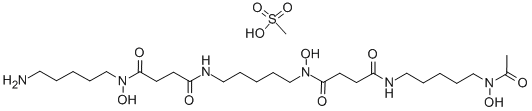
| 中文名称 | Deferoxamine mesylate |
| 英文名称 | Deferoxamine mesylate |
| CAS号 | 138-14-7 |
| 分子式 | C26H52N6O11S |
| 分子量 | 656.79 |
| EINECS号 | 205-314-3 |
| 熔点 | 148-149° |
| 溶解度 | H2O:50 mg/mL |
| 形态 | 粉末 |
| 颜色 | 白色至类白色 |
| 水溶解性 | Soluble to 100 mM in water |
| 安全说明 | 22-24/25 |
| WGK Germany | 2 |
| RTECS号 | UG5310000 |
| 海关编码 | 29280000 |
| 毒性 | man,TDLo,parenteral,16gm/kg/34W-I (16000mg/kg),CARDIAC: PERICARDITISGASTROINTESTINAL: ULCERATION OR BLEEDING FROM SMALL INTESTINEBLOOD: OTHER CHANGES,American Journal of Kidney Diseases. Vol. 10, Pg. 71, 1987. |
| Target | Value |
|
HIF-1α
() | |
|
Beta Amyloid
() | |
|
Ferroptosis
() |
Deferoxamine treatment significantly increases HIF-1α binding under all culture conditions, including hypoxic and high-glucose. The mechanism of deferoxamine is through improving HIF-1α biological function through scavenging oxygen free radicals. Deferoxamine (5 μM) has significant effect on the tumor-associated stromal cells cellular multiplication, and cells die at day 7 after exposure to 50 μM and 100 μM deferoxamine. Deferoxamine (5 μM-100 μM) inhibits the proliferation of BMMSCs, and induces apoptosis of MSCs in a dose-dependent manner. Deferoxamine influences the expression of adhesion proteins on MSCs. Deferoxamine (30, 60, 120 μM) shows lower expression of HIF-1α in a concentration dependent way in AdMSCs.
Deferoxamine (100 mg/kg, i.p.) lowers the mortality rate of subarachnoid hemorrhage (SAH) rat. Deferoxamine (100 mg/kg, i.p.) attenuates Evan’s blue extravasation in cortex, ameliorates the tight junction detachment and preserves the integrity of the base membrane examined in electron microscope at day 3 after SAH. Deferoxamine attenuates degradation of BBB proteins after SAH and significantly reduces ferritin expression at day 3 in the cortex, and improves neurologic behavior and cognitive deficits after experimental. Ten µL of 1 mM deferoxamine-treated wounds display significantly accelerated healing from day 7 onward and heal significantly faster than control-treated wounds in diabetic mice. Deferoxamine-treated wounds and dimethyloxalylglycine-treated wounds heal significantly faster than control-treated wounds in aged mice. In deferoxamine (10 mg/mL)-treated TG mice, there is a decrease in both soluble and insoluble Aβ40 and Aβ42. Both pGSK3β and β-catenin are significantly increased by approximately 50% in the deferoxamine-treated mice.
-
CAS号:16774-56-4
氯化铁铵 -
CAS号:14221-47-7
草酸高铁铵 -
CAS号:35745-11-0
田安 -
CAS号:138-14-7
甲磺酸去铁胺 -
CAS号:7783-85-9
硫酸亚铁铵,六水 -
CAS号:21265-50-9
乙二胺四乙酸铁铵 -
CAS号:25869-00-5
六氰合铁酸铵铁(III)(II) -
CAS号:13268-42-3
草酸高铁铵,三水合物 -
CAS号:127-07-1
羟基脲 -
CAS号:70-51-9
去铁胺 -
CAS号:1385-57-5
柠檬酸铁铵,棕色 -
CAS号:10138-04-2
硫酸铁铵 -
CAS号:1185-57-5
柠檬酸铁铵 -
CAS号:7783-83-7
硫酸高铁铵,十二水 -
CAS号:16774-56-4
氯化铁铵 -
CAS号:14221-47-7
草酸高铁铵 -
CAS号:35745-11-0
田安 -
CAS号:138-14-7
甲磺酸去铁胺 -
CAS号:7783-85-9
硫酸亚铁铵,六水 -
CAS号:21265-50-9
乙二胺四乙酸铁铵 -
CAS号:25869-00-5
六氰合铁酸铵铁(III)(II) -
CAS号:13268-42-3
草酸高铁铵,三水合物 -
CAS号:127-07-1
羟基脲 -
CAS号:70-51-9
去铁胺 -
CAS号:1385-57-5
柠檬酸铁铵,棕色 -
CAS号:10138-04-2
硫酸铁铵 -
CAS号:1185-57-5
柠檬酸铁铵 -
CAS号:7783-83-7
硫酸高铁铵,十二水