

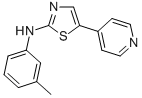
CAS号:315702-99-9
|
英文名称:STF-62247
分子式
C15H13N3S
分子量
267
EINECS号
631-141-1
MDL
MFCD01121974
Smiles
InChIKey
N-(3-甲基苯基)-4-(4-吡啶)-2-噻唑胺化学百科
基本信息
| 中文名称 | N-(3-甲基苯基)-4-(4-吡啶)-2-噻唑胺 |
| 英文名称 | STF-62247 |
| CAS号 | 315702-99-9 |
| 分子式 | C15H13N3S |
| 分子量 | 267.35 |
| EINECS号 | 631-141-1 |
物化性质
| 熔点 | 158-160℃ |
| 密度 | 1.255 |
| 溶解度 | 在DMSO中的溶解度为26mg/mL |
| 形态 | 固体 |
| 颜色 | 米白色 |
| 稳定性 | DMSO中的溶液可在-20°下稳定储存3个月。 |
安全信息
| 危险品标志 | Xn |
| 危险类别码 | 22-36 |
| 安全说明 | 26-39 |
| WGK Germany | 2 |
生产及用途
N-(3-甲基苯基)-4-(4-吡啶)-2-噻唑胺属于4-吡啶基-2-苯胺基噻唑(PAT)类化合物,对肾细胞癌(RCC)细胞具有细胞毒作用。晚期肾癌预后较差,肾细胞癌(RCC)往往对标准治疗无效。因此,晚期RCC的治疗具有尚未满足的临床需求。
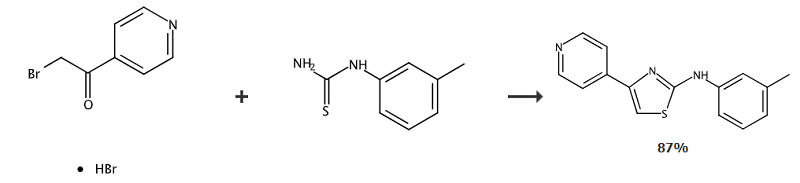
STF-62247对缺乏VHL的肾细胞具有选择毒性和抑制细胞生长作用;作用于VHL缺陷的细胞比作用于野生型(VHL+)选择性高25倍。In vitro, STF-62247 shows cytotoxicity and tumor growth inhibitory activity against wild-type VHL and VHL-deficient renal cell carcinoma (RCC) in a HIF-independent manner with IC50 of 16 μM and 0.625 μM, respectively. Moreover, STF-62247 also leads to cell death by increasing acidification and inducing autophagy in VHL-deficient cells. STF-62247 specifically induces macroautophagy and enhances the fusion of autophagosome and lysosomes to form autolysosomes by interfering with Golgi-endoplasmic reticulum transport in cells that have lost VHL . A recent study shows that induction of autophagy by STF-62247 increases sensitivity of RCC under hypoxic conditions to radiation in a VHL-dependent manner.In vivo mouse model, STF-62247 at a dose of 8 mg/kg byby intraperitoneal injection significantly reduces tumor growth of VHL-deficient SN12C tumor cells.在回流温度下,将溴酮氢溴酸盐(1.13 g,4.03 mmol)和3-甲基苯基硫脲(0.67 g,4.03 mmol)在EtOH(20 mL)中的混合物搅拌3 h。将混合物冷却至20℃,用水(50mL)稀释,将pH调节至约3。将其与NH3水溶液在8℃下混合,并将混合物在20℃下搅拌2h。过滤沉淀物,用水(5mL)洗涤并干燥。粗固体通过柱色谱法纯化,用EtOAc / pet的梯度(50-100%)洗脱得到N-(3-甲基苯基)-4-(4-吡啶)-2-噻唑胺(0.94 g,87%),为乳白色粉末。
在体外,STF-62247以HIF无关的方式对野生型VHL与VHL-缺陷型肾细胞癌(RCC)表现出细胞毒性和肿瘤生长抑制活性,IC50分别为16 μM和0.625 μM。此外,在VHL-缺陷细胞中,STF-62247也会通过增加酸化作用,并诱导自我吞噬,导致细胞死亡。 STF-62247特异性诱导巨自噬,并通过干扰VHL缺失的细胞中高尔基体-内质网转运,增强自噬体和溶酶体的融合以形成自溶酶体。一项最近的研究表明STF-62247的自我吞噬诱导以VHL依赖的方式增加低氧环境下RCC对辐射的敏感性。
在体内小鼠模型中,STF-62247(8 mg/kg,i.p.)显著降低VHL-缺失的SN12C肿瘤细胞中的肿瘤生长。上下游产品
上游产品共计:0个
下游产品共计:0个
相关产品
-
CAS号:443913-73-3
凡德他尼 , 是有效的 VEGFR2 抑制剂,IC50 为40 nM -
CAS号:53123-88-9
雷帕霉素 -
CAS号:154447-36-6
LY294002 -
CAS号:85622-93-1
替莫唑胺 , -
CAS号:641571-10-0
尼罗替尼 -
CAS号:183322-45-4
6,7-二甲氧基-4-[N-(3-溴苯基)氨基]喹唑啉盐酸盐 -
CAS号:19545-26-7
渥曼青霉素 -
CAS号:184475-35-2
吉非替尼 -
CAS号:5142-23-4
3-甲基腺嘌呤 -
CAS号:103-84-4
N-乙酰苯胺 -
CAS号:443913-73-3
凡德他尼 , 是有效的 VEGFR2 抑制剂,IC50 为40 nM -
CAS号:53123-88-9
雷帕霉素 -
CAS号:154447-36-6
LY294002 -
CAS号:85622-93-1
替莫唑胺 , -
CAS号:641571-10-0
尼罗替尼 -
CAS号:183322-45-4
6,7-二甲氧基-4-[N-(3-溴苯基)氨基]喹唑啉盐酸盐 -
CAS号:19545-26-7
渥曼青霉素 -
CAS号:184475-35-2
吉非替尼 -
CAS号:5142-23-4
3-甲基腺嘌呤 -
CAS号:103-84-4
N-乙酰苯胺
产品供应商