

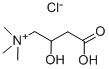
| 中文名称 | DL-肉碱盐酸盐 |
| 英文名称 | DL-Carnitine hydrochloride |
| CAS号 | 461-05-2 |
| 分子式 | C7H16ClNO3 |
| 分子量 | 197.66 |
| EINECS号 | 207-309-1 |
| 熔点 | 197-199 °C |
| 比旋光度 | -0.2~+0.2°(20℃/D)(c=5,H2O) |
| 溶解度 | 可溶于水基(轻微)、甲醇(轻微、加热)、水(少量、超声处理) |
| 形态 | 粉末、晶体、针状物和/或块状物 |
| 颜色 | 白色到近乎白色 |
| PH值 | 1.8-2.5 (100g/l, H2O) |
| 水溶解性 | SOLUBLE |
| 敏感性 | Hygroscopic |
| 默克索引编号 | 14,1849 |
| BRN | 4163212 |
| 稳定性 | 吸湿性 |
| 危险品标志 | Xi |
| 危险类别码 | 36/37/38 |
| 安全说明 | 26-36-37/39 |
| WGK Germany | 3 |
| RTECS号 | BP2979140 |
| TSCA | Yes |
| 海关编码 | 29239000 |
| 毒性 | LD50 subcutaneous in mouse: 6gm/kg |
DL-肉碱盐酸盐可用于食品添加剂和辅助治疗剂。
DL-肉碱盐酸盐是氨基酸赖氨酸和蛋氨酸生物合成的一种季铵化合物。
The main role of L-carnitine is to shuttle long-chain fatty acids across the inner mitochondrial membrane. After L-carnitine and acyl-CoA become acyl-carnitine by activation of carnitine palmitoyl transferase (CPT)-I, the transported acyl-carnitine is changed into acyl-CoA by CPT-II in the mitochondria matrix. Palmitoyl-CoA-induced mitochondrial respiration is increased by L-carnitine treatment, and then is accelerated by the presence of ADP. This acceleration is induced by treatment with L-carnitine in a concentration-dependent manner, and is saturated at 5 mM L-carnitine. Pretreatment with L-carnitine augments Nrf2 nuclear translocation, DNA binding activity and heme oxygenase-1 (HO-1) expression in H 2 O 2 -treated HL7702 cells. L-carnitine protects HL7702 cells against H 2 O 2 -induced cell damage through Akt-mediated activation of Nrf2 signaling pathway.
L-carnitine is found to down-regulate the ubiquitin proteasome pathway and increase IGF-1 concentrations in animal models. L-carnitine administration for 2 weeks of hindlimb suspension alleviates the decrease in weight and fiber size in the soleus muscle. In addition, L-carnitine suppresses atrogin-1 mRNA expression, which has been reported to play a pivotal role in muscle atrophy. Simultaneous treatment with L-carnitine attenuates the renal fibrosis (which correlated with a reduction of plasma TGF-β1 levels) and the pro-oxidative and proinflammatory status reported in L-NAME groups, with a concomitant increase in the expression of PPAR-γ.
-
CAS号:628-13-7
吡啶盐酸盐 -
CAS号:554-68-7
三乙胺盐酸盐 -
CAS号:127913-44-4
(S)-4-氯-3-羟基丁腈 -
CAS号:105-33-9
4-氯-3-羟基丁腈 -
CAS号:66-84-2
D-(+)-葡萄糖胺盐酸盐 -
CAS号:2788-28-5
L-卡内腈 -
CAS号:6490-20-6
左卡尼汀杂质3 -
CAS号:119413-54-6
盐酸拓扑替康 -
CAS号:593-56-6
甲氧胺盐酸盐 -
CAS号:541-15-1
左旋肉碱 -
CAS号:36687-82-8
左旋肉碱酒石酸盐 -
CAS号:657-27-2
L-赖氨酸盐酸盐 -
CAS号:124-83-4
D-樟脑酸 -
CAS号:927-89-9
巴豆 -
CAS号:521-13-1
胆固醇丁酸酯 -
CAS号:461-06-3
γ-三甲铵-β-羟基丁酸 -
CAS号:1914-99-4
偶氮氯膦Ⅲ -
CAS号:628-13-7
吡啶盐酸盐 -
CAS号:554-68-7
三乙胺盐酸盐 -
CAS号:127913-44-4
(S)-4-氯-3-羟基丁腈 -
CAS号:105-33-9
4-氯-3-羟基丁腈 -
CAS号:66-84-2
D-(+)-葡萄糖胺盐酸盐 -
CAS号:2788-28-5
L-卡内腈 -
CAS号:6490-20-6
左卡尼汀杂质3 -
CAS号:119413-54-6
盐酸拓扑替康 -
CAS号:593-56-6
甲氧胺盐酸盐 -
CAS号:541-15-1
左旋肉碱 -
CAS号:36687-82-8
左旋肉碱酒石酸盐 -
CAS号:657-27-2
L-赖氨酸盐酸盐 -
CAS号:124-83-4
D-樟脑酸 -
CAS号:927-89-9
巴豆 -
CAS号:521-13-1
胆固醇丁酸酯 -
CAS号:461-06-3
γ-三甲铵-β-羟基丁酸 -
CAS号:1914-99-4
偶氮氯膦Ⅲ