

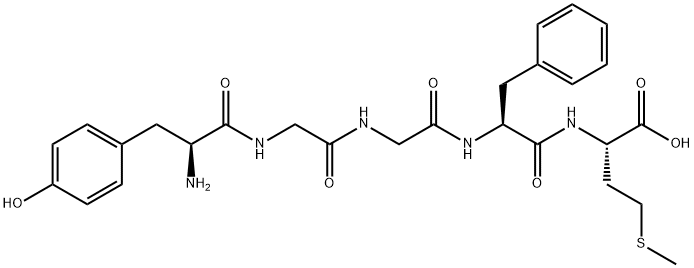
CAS号:58569-55-4
|
英文名称:Met-Enkephalin acetate salt
分子式
C27H35N5O7S
分子量
574
EINECS号
261-335-8
MDL
MFCD00076415
Smiles
InChIKey
蛋氨酸脑啡肽化学百科
基本信息
| 中文名称 | [MET5]脑啡肽 |
| 英文名称 | H-TYR-GLY-GLY-PHE-MET-OH |
| CAS号 | 58569-55-4 |
| 分子式 | C27H35N5O7S |
| 分子量 | 573.66 |
| EINECS号 | 261-335-8 |
物化性质
| 熔点 | 174-177 °C |
| 比旋光度 | +31.5°(D/25℃)(c=0.96,メタノール) |
| 沸点 | 1052.9±65.0 °C(Predicted) |
| 密度 | 1.324±0.06 g/cm3(Predicted) |
| 溶解度 | DMSO(轻微)、甲醇(轻微、加热、超声处理)、水(轻微) |
| 形态 | 粉末 |
| 酸度系数(pKa) | 3.23±0.10(Predicted) |
| 颜色 | 白色 |
| 稳定性 | 在碱性溶液中不稳定 |
安全信息
| 安全说明 | 22-24/25 |
| WGK Germany | 3 |
生产及用途
Tyr-Gly-Gly-Phe-Met-OH 通过结合阿片样物质受体 (opioid receptor),可调控人类免疫功能,抑制肿瘤生长。
纯度(HPLC) ≥98.0%
醋酸根含量≤12.0%
水分含量≤8.0%
肽含量≥80.0%
内毒素≤50EU/mg
氨基酸组成分析≤±10%
Opioid Receptor.
Methionine enkephalin (MENK), an endogenous neuropeptide has a crucial role in both neuroendocrine and immune systems. MENK is believed to have an immunoregulatory activity to have cancer biotherapy activity by binding to the opioid receptors on immune and cancer cells. MENK may also change the tumor microenvironment by binding to opioid receptor on or in cancer cells. All of these mechanisms of action have biologic significance and potential for use in cancer immunotherapy. Furthermore, they reveal a relationship between the endocrine and immune systems.
化学性质
白色或类白色粉末,由5个氨基酸组成,顺序为L-酪氨酸、甘氨酸、L-苯丙氨酸、L-甲硫氨酸。参考质量标准
外观:白色粉末纯度(HPLC) ≥98.0%
醋酸根含量≤12.0%
水分含量≤8.0%
肽含量≥80.0%
内毒素≤50EU/mg
氨基酸组成分析≤±10%
用途
用于生化研究,神经生物学研究。生产方法
以L-酪氨酸、甘氨酸、L-苯丙氨酸、L-甲硫氨酸为原料,先将氨基酸中有侧链的氨基酸的侧链按其特性分别用保护剂保护后,在多肽缩合剂存在下进行缩合反应,然后除去保护剂纯化制得。上下游产品
产品供应商