

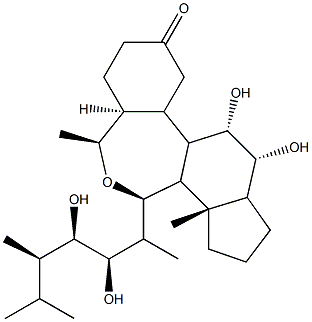
| 中文名称 | 表油菜素内酯 |
| 英文名称 | Epibrassinolide |
| CAS号 | 78821-43-9 |
| 分子式 | C28H48O6 |
| 分子量 | 480.68 |
| EINECS号 | 639-387-1 |
| 熔点 | 256°C |
| 沸点 | 633.7±55.0 °C(Predicted) |
| 密度 | 1.141±0.06 g/cm3(Predicted) |
| 溶解度 | 氯仿(微溶)、乙酸乙酯(微溶) |
| 形态 | 固体 |
| 酸度系数(pKa) | 14.27±0.70(Predicted) |
| 颜色 | 白色至类白色 |
| 危险类别码 | 22-36/37/38 |
| 安全说明 | 22-36/37/39-45 |
| WGK Germany | 3 |
| 海关编码 | 29372900 |
Plant growth regulator, Apoptosis inducer
Epibrassinolide (EBR) is a biologically active compound of the brassinosteroids, steroid-derived plant growth regulator family. Cells are incubated with various doses (0-100 μM) of Epibrassinolide for 24 or 48 h and cell viability is determined by MTT assay. Epibrassinolide induced cell viability loss in dose- and time-dependent manner compared to untreated samples in LNCaP and DU145 prostate cancer cells. Increasing concentrations of Epibrassinolide is more effective on LNCaP cell viability loss than DU145 cells suggesting that androgen-dependent cells are more sensitive to Epibrassinolide than androgen-independent prostate cancer cells. In further experiments, 25 μM Epibrassinolide is selected due to its moderate cytotoxic effect on both cell lines. The effect of Epibrassinolide treatment is examined on cell proliferation by counting the cell number within 96 h. A higher and earlier inhibition of cell proliferation is observed in LNCaP than DU145 cells.
-
CAS号:74174-44-0
28-高油菜素内酯 -
CAS号:60207-90-1
丙环唑 -
CAS号:110369-52-3
28-表高芸苔素内酯 -
CAS号:7287-19-6
扑草净 -
CAS号:80483-89-2
芸苔素内酯 -
CAS号:1582-09-8
氟乐灵 -
CAS号:481-21-0
5α-胆甾烷 -
CAS号:83657-22-1
烯效唑 -
CAS号:76738-62-0
多效唑 -
CAS号:72962-43-7
表油菜素内酯 -
CAS号:1214-39-7
6-苄氨基嘌呤 -
CAS号:78821-43-9
表油菜素内酯 -
CAS号:999-81-5
矮壮素 -
CAS号:74174-44-0
28-高油菜素内酯 -
CAS号:60207-90-1
丙环唑 -
CAS号:110369-52-3
28-表高芸苔素内酯 -
CAS号:7287-19-6
扑草净 -
CAS号:80483-89-2
芸苔素内酯 -
CAS号:1582-09-8
氟乐灵 -
CAS号:481-21-0
5α-胆甾烷 -
CAS号:83657-22-1
烯效唑 -
CAS号:76738-62-0
多效唑 -
CAS号:72962-43-7
表油菜素内酯 -
CAS号:1214-39-7
6-苄氨基嘌呤 -
CAS号:78821-43-9
表油菜素内酯 -
CAS号:999-81-5
矮壮素