

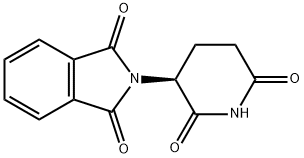
| 中文名称 | (-)-沙利度胺 |
| 英文名称 | (-)-THALIDOMIDE |
| CAS号 | 841-67-8 |
| 分子式 | C13H10N2O4 |
| 分子量 | 258.23 |
| EINECS号 | 635-910-2 |
| 熔点 | 269-271°C |
| 沸点 | 401.48°C (rough estimate) |
| 密度 | 1.2944 (rough estimate) |
| 折射率 | 1.5300 (estimate) |
| 溶解度 | 可溶于DMSO |
| 形态 | 固体 |
| 酸度系数(pKa) | 10.70±0.40(Predicted) |
| 颜色 | 白色 |
| 旋光性 (optical activity) | [α]23/D 62.6°, c = 2 in DMF(lit.) |
| 危险品标志 | T |
| 危险类别码 | 61-22 |
| 安全说明 | 53-36/37/39-45 |
| 危险品运输编号 | UN 2811 6.1/PG 2 |
| WGK Germany | 3 |
| RTECS号 | TI4925050 |
Apoptosis
(S)-Thalidomide treatment results in a reduction in cell viability in U266 cells with an IC
50
of 362 μM.
(S)-Thalidomide treatment increased apoptosis in a dose-dependent manner in U266 cells.
There are changes in the expression profile of genes involved in angiogenesis and apoptosis, but the changes are most dramatic in the apoptotic genes. In particular, the expression of I-κB kinase is decreased by two-fold, which is associated with a four-fold decrease in NF-κB expression. (S)-Thalidomide increases the Bax:Bcl-2 ratio, also increases I-kB protein levels, and decreases NF-kB activity. A dramatic decrease in Bcl-2 expression with (S)-Thalidomide suggests a possible enhancement of cytotoxic effect if combined with other cytotoxic agents.
Cell Viability Assay
| Cell Line: | U266 MM cells |
| Concentration: | 0 µM, 10 µM, 100 µM, 150 µM, 200 µM, 1000 µM |
| Incubation Time: | 3 days |
| Result: | A reduction in cell viability was observed in U266 cells. |
Apoptosis Analysis
| Cell Line: | U266 MM cells |
| Concentration: | 100 µM, 150 µM, 200 µM, 1000 µM |
| Incubation Time: | 3 days |
| Result: | Increased apoptosis in U266 cells. |
Thalidomide does cause limb reduction defects in chick embryos as long as the embryos are directly exposed to the drug. The most useful techniques are implanting Thalidomide-soaked beads into the embryo immediately adjacent to the limb territory or soaking presumptive chick limb territories in Thalidomide and then grafting the explants to a host embryo celom. Thalidomide affects the chick limb grafted to a host embryo in a dose response fashion. Furthermore, (S)-Thalidomide is more teratogenic than (R)-Thalidomide.
-
CAS号:50-35-1
沙利度胺 , 最初是一种镇静剂, 能够抑制CRBN , Kd值约为250 nM, 具有免疫调节, 抗炎, 抗肿瘤作用 -
CAS号:34294-79-6
(S)-3-氨基哌啶-2-酮盐酸盐 -
CAS号:80918-66-7
(S)-3-氨基哌啶 -
CAS号:54012-73-6
3-氨基哌啶 -
CAS号:841-67-8
(S)-(-)-沙利度胺 -
CAS号:1892-22-4
3-氨基哌啶-2-酮 -
CAS号:50-35-1
沙利度胺 , 最初是一种镇静剂, 能够抑制CRBN , Kd值约为250 nM, 具有免疫调节, 抗炎, 抗肿瘤作用 -
CAS号:34294-79-6
(S)-3-氨基哌啶-2-酮盐酸盐 -
CAS号:80918-66-7
(S)-3-氨基哌啶 -
CAS号:54012-73-6
3-氨基哌啶 -
CAS号:841-67-8
(S)-(-)-沙利度胺 -
CAS号:1892-22-4
3-氨基哌啶-2-酮