

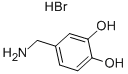
| 中文名称 | 3,4-二羟基苄胺·氢溴酸 |
| 英文名称 | 3,4-DIHYDROXYBENZYLAMINE HYDROBROMIDE |
| CAS号 | 16290-26-9 |
| 分子式 | C7H10BrNO2 |
| 分子量 | 220.06 |
| EINECS号 | 240-382-8 |
| 熔点 | 184-186 °C(lit.) |
| 溶解度 | 可溶于DMSO(轻微)、甲醇(非常轻微) |
| 形态 | 结晶粉末 |
| 颜色 | 浅米色低熔点 |
| 敏感性 | Hygroscopic |
| BRN | 4002646 |
| 危险品标志 | Xi |
| 危险类别码 | 36/37/38 |
| 安全说明 | 26-36 |
| WGK Germany | 3 |
| 海关编码 | 29222900 |
3,4-Dihydroxybenzylamine hydrobromide (1 μM-10 mM; 48 hours) inhibits the growth of all melanoma cell lines with an IC 50 of 100 μM, while the SK-MELB cell line exhibits an IC 50 of 122 μM. The IC 50 values are 30, 84,90, and 68 μM for Human SK-MEL-30, SK-MEL-2, SK-MEL-3,RPMI-7951 cells, respectively. It exhibits IC 50 values of 10, 25, 67, and 184 μM for S91A,S91B, L1210, and SCC-25 cells, respectively.3,4-Dihydroxybenzylamine hydrobromide (1 μM-10 mM; 48 hours) cytotoxicity in SK-MEL-2 and SK-MEL-28 cell lines can be enhanced by application of buthionine sulfoximine (BSO). BSO treatment sensitizes marginally pigmented cells to the effects of 3,4-DHBA, and the presence of decreses IC 50 values of 3,4-DHBA by 127% in the SK-MEL-28 cell line and by 148% in the SK-MEL-2 cell line.
Cell Viability Assay
| Cell Line: | Human and Murine Melanoma Cell Lines; Non-Melanoma Cell Lines |
| Concentration: | 1 μM-10 mM |
| Incubation Time: | 48 hours |
| Result: | Inhibited melanoma cell Lines growth. |
3,4-Dihydroxybenzylamine hydrobromide (intraperitoneal injection; 1000 mg/kg; 7 days) has the least toxic effect in non-tumor-bearing B6D2F1 mice,and mice is tolerated at this dose. 3,4-Dihydroxybenzylamine hydrobromide (intraperitoneal injection; 200-800 mg/kg; 21 days) has different effects at different doses, the median life-span are 17, 24.5, 26, 29 and 25 days for 0 mg/kg, 200 mg/kg, 400 mg/kg, 600 mg/kg, and 800 mg/kg, respectively.
| Animal Model: | C57BL/6 mice with B6D2F1 cells |
| Dosage: | 200 mg/kg, 400 mg/kg, 600 mg/kg, and 800 mg/kg |
| Administration: | Intraperitoneal injection |
| Result: | Exhibited increased life-span of 44%,46%, 70% and 50% for 200 mg/kg, 400 mg/kg, 600 mg/kg, and 800 mg/kg, respectively. |
-
CAS号:53392-66-8
DL-6'-溴代劳丹素 -
CAS号:52768-23-7
四氢-6,7-异喹啉二醇 -
CAS号:16290-26-9
3,4-二羟基苄胺氢溴酸 -
CAS号:1953-04-4
氢溴酸加兰他敏 -
CAS号:73604-30-5
(-)-双小分子甲基溴化物 -
CAS号:89505-76-0
Lycoramine -
CAS号:10035-10-6
氢溴酸 , 40% , 用于分析 -
CAS号:485-33-6
DL-氢溴酸劳丹素 -
CAS号:120-80-9
邻苯二酚 -
CAS号:16659-88-4
氢溴酸(+-)-四氢罂粟林 -
CAS号:53392-66-8
DL-6'-溴代劳丹素 -
CAS号:52768-23-7
四氢-6,7-异喹啉二醇 -
CAS号:16290-26-9
3,4-二羟基苄胺氢溴酸 -
CAS号:1953-04-4
氢溴酸加兰他敏 -
CAS号:73604-30-5
(-)-双小分子甲基溴化物 -
CAS号:89505-76-0
Lycoramine -
CAS号:10035-10-6
氢溴酸 , 40% , 用于分析 -
CAS号:485-33-6
DL-氢溴酸劳丹素 -
CAS号:120-80-9
邻苯二酚 -
CAS号:16659-88-4
氢溴酸(+-)-四氢罂粟林