

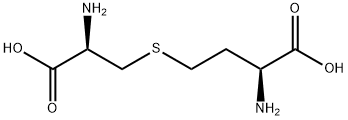
| 中文名称 | L-胱硫醚 |
| 英文名称 | L-CYSTATHIONINE |
| CAS号 | 56-88-2 |
| 分子式 | C7H14N2O4S |
| 分子量 | 222.26 |
| EINECS号 | 200-295-8 |
| 熔点 | 312 |
| 比旋光度 | D20 +23.7° (1N HCl) |
| 沸点 | 481.0±45.0 °C(Predicted) |
| 密度 | 1.430±0.06 g/cm3 (20 ºC 760 Torr) |
| 溶解度 | 酸水溶液(微溶) |
| 形态 | 固体 |
| 酸度系数(pKa) | 2.08±0.10(Predicted) |
| 颜色 | 白色至类白色 |
| 旋光性 (optical activity) | +26.425 (1 mol dm-3 HCl) |
| 默克索引编号 | 13,2807 |
| BRN | 2505200 |
| WGK Germany | 3 |
| 海关编码 | 29309090 |
|
Human Endogenous Metabolite
|
Homocysteine obviously induces the apoptosis of HUVECs, and this effect is significantly attenuated by the pretreatment with L-cystathionine. Furthermore, L-cystathionine decreases the production of mitochondrial superoxide anion and the expression of Bax and restrained its translocation to mitochondria, increases mitochondrial membrane potential, inhibits mitochondrial permeability transition pore (MPTP) opening, suppresses the leakage of cytochrome c from mitochondria into the cytoplasm, and downregulated activities of caspase-9 and caspase-3.
L-Cystathionine is an important metabolic intermediate in the L-cysteine transsulfuration pathway from L-methionine via L-homocysteine in mammalian tissues.
由邻琥珀酰高丝氨酸与半胱氨酸作用生成。胱硫醚被胱硫醚β
-
裂解酶作用脱去丙酮酸和
NH3
后生成高半胱氨酸。