

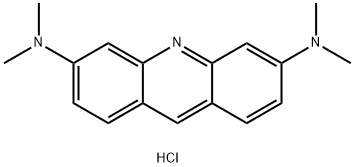
| 中文名称 | 3,6-双(二甲基氨基)吖啶 |
| 英文名称 | ACRIDINE ORANGE |
| CAS号 | 65-61-2 |
| 分子式 | C17H20ClN3 |
| 分子量 | 301.82 |
| EINECS号 | 200-614-0 |
| 熔点 | 284-287 °C(lit.) |
| 密度 | 1.001 g/mL at 20 °C |
| 折射率 | n20/D 1.338 |
| 溶解度 | 易溶于水、乙醇、二甲基亚砜 |
| 色指数 | 46005 |
| 形态 | 粉末 |
| 酸度系数(pKa) | -3.2, 10.5(at 25℃) |
| 颜色 | 橙色至红色 |
| 最大波长(λmax) | 500 nm |
| BRN | 3734978 |
| 生物领域应用 | Detecting cancer cells,spores,human papilloma virus (HPV),stress biomarkers; treating amyloid associated diseases,lupus,pathogen infections; apoptosis assays; cytotoxicity assays |
| 主要应用 | Adhesives; aluminophosphate crystalline materials; detecting clay particles; display device; evaluating fiber surface characteristics; glass matrixes; imaging material; inks; lasers; recording materials; photoresists; textiles; thin films; tracers for hydrology; wiring boards |
| 安全说明 | 22-24/25 |
| WGK Germany | 3 |
| RTECS号 | AR7601000 |
| 海关编码 | 32041300 |
| 毒性 | dnd-mus:ast 20 mmol/L BBACAQ 374,96,74 |
Acridine Orange has been employed extensively as a cytochemical stain and has shown to stain differentially DNA and RNA, and double-restranded nucleic acids in situ . Acridine Orange can either intercalate into double helical nucleic acids (green fluorescence at 530 nm), or bind electrostatically to phosphate groups of single-stranded molecules (red fluorescence at 640 nm). This unique characteristic makes acridine orange useful for cell-cycle studies. Acridine Orange staining of unfixed cells may be used as a simple, fast means of obtaining information on cell ploidy levels and cell cycle status from DNA measurements (green fluorescence), and cell transcriptional activity from RNA staining (red fluorescence), in human and murine cells lines, peripheral blood and bone marrow specimens from patients with leukemia and mitogenically (phytohemagglutinin) or antigenically (mixed lymphocyte culture) stimulated human peripheral blood cultures.
-
CAS号:75168-11-5
10-壬基吖啶橙溴化物 -
CAS号:580-19-8
7-氨基喹啉 -
CAS号:65-61-2
吖啶橙盐酸盐 , =99% -
CAS号:75168-16-0
10-十八烷基丫啶橙溴 -
CAS号:8048-52-0
吖啶黄素 (3,6-二氨基-10-甲基吖啶盐酸盐和3,6-二氨基吖啶的混合物) , 70.0%(LC) -
CAS号:494-38-2
吖啶橙 -
CAS号:952-23-8
原黄素盐酸盐 -
CAS号:1811-28-5
硫酸原黄素 -
CAS号:17784-47-3
盐酸丫啶 -
CAS号:10127-02-3
碱性橙 14 -
CAS号:260-94-6
吖啶 -
CAS号:75168-11-5
10-壬基吖啶橙溴化物 -
CAS号:580-19-8
7-氨基喹啉 -
CAS号:65-61-2
吖啶橙盐酸盐 , =99% -
CAS号:75168-16-0
10-十八烷基丫啶橙溴 -
CAS号:8048-52-0
吖啶黄素 (3,6-二氨基-10-甲基吖啶盐酸盐和3,6-二氨基吖啶的混合物) , 70.0%(LC) -
CAS号:494-38-2
吖啶橙 -
CAS号:952-23-8
原黄素盐酸盐 -
CAS号:1811-28-5
硫酸原黄素 -
CAS号:17784-47-3
盐酸丫啶 -
CAS号:10127-02-3
碱性橙 14 -
CAS号:260-94-6
吖啶