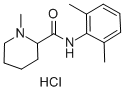
CAS号:1722-62-9
|
英文名称:Mepivacaine hydrochloride
分子式
C15H22N2O.ClH
分子量
283
EINECS号
217-023-9
MDL
MFCD00144738
Smiles
InChIKey
盐酸甲哌卡因化学百科
基本信息
| 中文名称 | 盐酸甲哌卡因 |
| 英文名称 | Mepivacaine hydrochloride |
| CAS号 | 1722-62-9 |
| 分子式 | C15H22N2O.ClH |
| 分子量 | 282.81 |
| EINECS号 | 217-023-9 |
| InChI | InChI=1S/C15H22N2O.ClH/c1-11-7-6-8-12(2)14(11)16-15(18)13-9-4-5-10-17(13)3;/h6-8,13H,4-5,9-10H2,1-3H3,(H,16,18);1H |
| SMILES | C1(=C(C)C=CC=C1C)NC(=O)C1CCCCN1C.Cl |
物化性质
| 熔点 | 255-257°C (dec.) |
| 溶解度 | 在水中的溶解度为20mg/mL,澄清 |
| 形态 | 粉末 |
| 颜色 | 白色至米色 |
安全信息
| 危险品标志 | Xn |
| 危险类别码 | 22 |
| 安全说明 | 22-24/25 |
| 危险品运输编号 | UN 2811 6.1 / PGIII |
| RTECS号 | TK6475000 |
| 海关编码 | 29333990 |
| 毒性 | LD50 in mice, rats (mg/kg): 280, 500 s.c. (Aberg) |
生产及用途
Mepivacaine 是一种叔胺,用作局部麻醉剂。
对马的测试表明,与根据以前解剖的,乳胶注射后得到的假定相比,mepivacaine在相邻关节结构间具有更大的扩撒,与关节造影研究形成对比。经历膝关节镜检查患者中,与神经刺激相比较,超声处理使1.5% mepivacaine阻断坐骨神经所需的最低有效麻醉剂体积(MEAV50)减少37%。在犬齿和前臼齿中,lidocaine制剂与肾上腺素相比,3%mepivacaine的使用使麻醉时间间隔更短。
Mepivacaine hydrochloride binds to specific voltage-gated sodium ion channels in neuronal cell membranes, which inhibits both sodium influx and membrane depolarization. This leads to a blockage of nerve impulse initiation and conduction and results in a reversible loss of sensation. Compared to other local anesthetics, this agent has a more rapid onset and moderate duration of action.
Mepivacaine hydrochloride has a reasonably rapid onset (more rapid than that of procaine) and medium duration of action (shorter than that of procaine).
Mepivacaine hydrochloride displays a preferential use-dependent block of Na(v)1.8, S(-)-bupivacaine displays a preference for TTXs Na(+) channels.
类别
有毒物质毒性分级
中毒急性毒性
腹腔-小鼠 LD50: 117 毫克/公斤; 静脉-小鼠 LD50: 35 毫克/公斤可燃性危险特性
热分解排出有毒氮氧化物烟雾储运特性
库房低温通风干燥灭火剂
水, 二氧化碳, 泡沫, 干粉上下游产品
相关产品
-
CAS号:99-76-3
4-羟基苯甲酸甲酯 , 用于合成 -
CAS号:132112-35-7
盐酸罗哌卡因 -
CAS号:83055-99-6
苄嘧磺隆 -
CAS号:68-12-2
N,N-二甲基甲酰胺 , 99.8% , 超干溶剂, J&KSeal瓶, 水:≤30 ppm, 带分子筛 -
CAS号:119413-54-6
盐酸拓扑替康 -
CAS号:2180-92-9
丁吡卡因 -
CAS号:91599-74-5
盐酸贝尼地平 -
CAS号:120011-70-3
盐酸多奈哌齐 , 是非竞争性的AChE抑制剂, 能穿过血脑屏障, 增加皮质中的乙酰胆碱水平 -
CAS号:143390-89-0
醚菌酯 -
CAS号:119615-63-3
Olprinone (Hydrochloride) -
CAS号:23564-05-8
甲基硫菌灵 -
CAS号:119-36-8
水杨酸甲酯 -
CAS号:34552-83-5
盐酸洛哌丁胺 -
CAS号:74-83-9
溴甲烷 -
CAS号:74223-64-6
甲磺隆 -
CAS号:99-76-3
4-羟基苯甲酸甲酯 , 用于合成 -
CAS号:132112-35-7
盐酸罗哌卡因 -
CAS号:83055-99-6
苄嘧磺隆 -
CAS号:68-12-2
N,N-二甲基甲酰胺 , 99.8% , 超干溶剂, J&KSeal瓶, 水:≤30 ppm, 带分子筛 -
CAS号:119413-54-6
盐酸拓扑替康 -
CAS号:2180-92-9
丁吡卡因 -
CAS号:91599-74-5
盐酸贝尼地平 -
CAS号:120011-70-3
盐酸多奈哌齐 , 是非竞争性的AChE抑制剂, 能穿过血脑屏障, 增加皮质中的乙酰胆碱水平 -
CAS号:143390-89-0
醚菌酯 -
CAS号:119615-63-3
Olprinone (Hydrochloride) -
CAS号:23564-05-8
甲基硫菌灵 -
CAS号:119-36-8
水杨酸甲酯 -
CAS号:34552-83-5
盐酸洛哌丁胺 -
CAS号:74-83-9
溴甲烷 -
CAS号:74223-64-6
甲磺隆
产品供应商